Six digital signals, measured in real life
A neurologist sees their patient 15 minutes every 6 months. We observe seven cognitive domains every day, inside a game the person wants to open. The difference is the substrate: the training material is the user’s own life, which turns every game into an ecological measurement impossible to obtain in the clinic.
Three layers of evidence
Clinical instrument of origin
Each signal starts from a construct validated in the literature: composite indices, IIV, recency ratio, error analysis, autobiographical specificity, voice.
Published predictive validation
Work showing the construct anticipates decline: variability as an early predictor, the recent-remote gradient, speech markers.
The Noa extension
The same construct, measured continuously on personal autobiographical substrate. New statistical objects on published foundations.
The six signals, in earnest
Global cognitive trajectory
Aggregated performance across cognitive domains, measured in every game session and tracked longitudinally against the personal baseline.
Intra-individual variability
Performance inconsistency across sessions as a signal in its own right, not noise. Continuously, not in quarterly visits.
Recent-remote asymmetry
The balance between recent and remote memory, computed on the user’s own real autobiographical material.
Error patterns
Not just how many mistakes: what shape they take. Omissions, intrusions and confabulations are labelled and tracked separately.
Multi-domain autobiographical memory
The richness and specificity of autobiographical recall over time, on the user’s own life story.
Vocal coherence
Acoustic and linguistic parameters extracted on-device while the user narrates their memories. In production since May 2026.
We also keep a 49-page literature review documenting each signal with its references. We share it with interested researchers: ask us for it.
We won’t just tell you: browse it
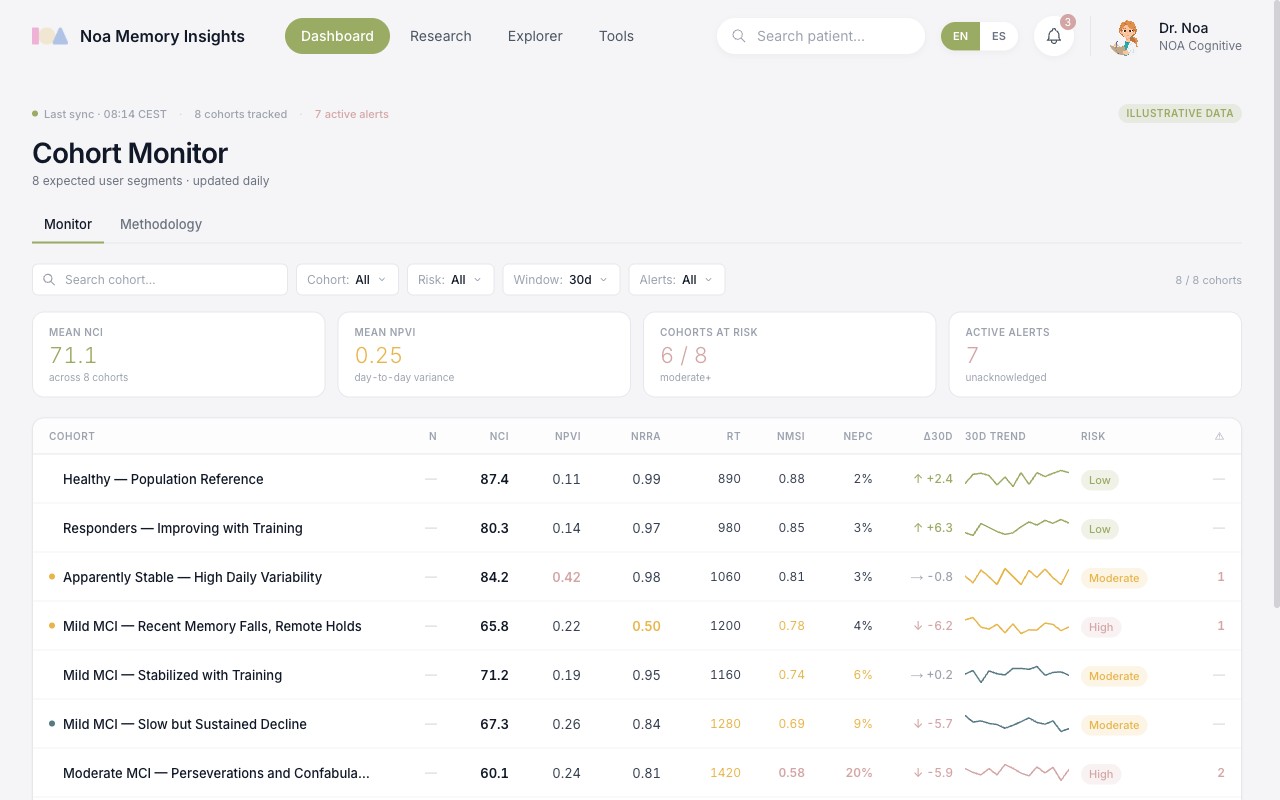
A cohort monitor with the six signals in action: 30-day trends, variability, alerts and the methodology explained. What you see is the panel’s full potential; what you don’t see is the exact computation behind each signal, which is our core. Illustrative data, no real patients.
What we have and what we don’t, yet
We have
- · A six-biomarker pipeline running in production
- · An onboarding with four mini-games porting validated instruments
- · A complete pre-registered trial protocol (N=100, 6 months)
- · Thousands of real sessions with per-task metrics
Not yet
- · Peer-reviewed efficacy data: the pilot is designed precisely to produce it
- · Formal clinical collaborations: we want to build them, hence this page
What we offer a clinical group
Interoperability
Data exportable in HL7 FHIR R4, compatible with any hospital system.
Clinical coding
27 ICD-10-CM codes mapped: G31.84 (MCI), G30.x (Alzheimer’s), CPT 97129.
Longitudinal signals
A panel of continuous digital biomarkers, measured in every session, exportable in standard clinical formats.
Proposed pilot
100 patients, 6 months, zero cost for the clinician. Co-authorship of the paper.